You can find anything online, right? Who documented all this old stuff, and who posts it for the rest of us around the world? Finding mimeographed copies of my elementary school newspaper on Facebook reminded me of the mimeograph and, not surprisingly, I found a photo of a mimeograph machine online.
#The stack of blank paper to feed the machine is on the right in the photo below; the stencil is attached to the drum; the man is turning the drum counterclockwise to feed the paper under the drum; and the finished copy appears on the left.
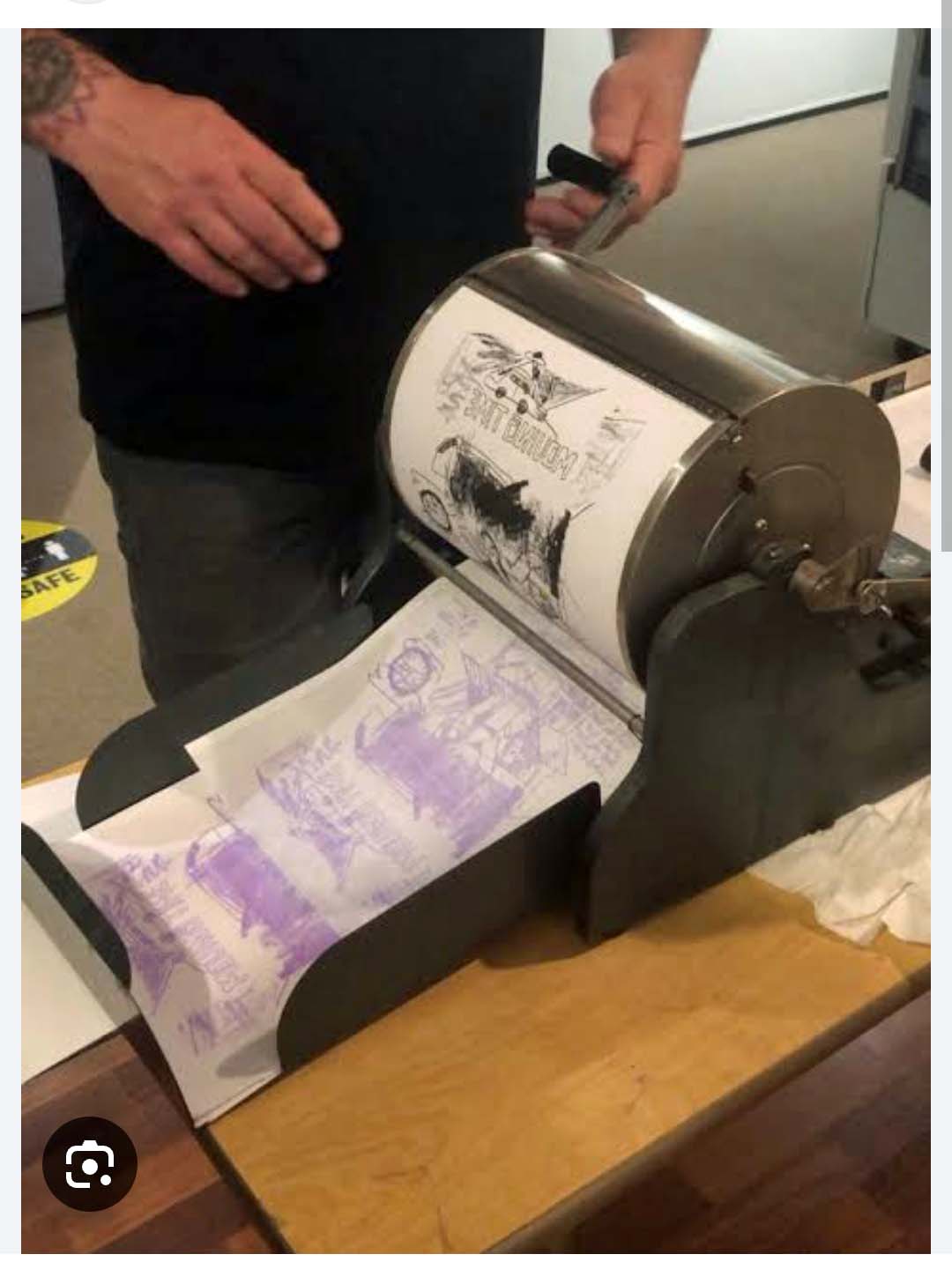
My elementary school teachers used mimeographed worksheets for all of our classwork. First, they typed text or used a specially-designed electric pen to draw an image on a wax-coated paper stencil. The finished stencil had holes in it to allow ink to pass through to a sheet of paper. Our teachers always made the stencils but, sometimes, we students were allowed to make the copies. What fun to turn the drum and watch our worksheets appear! A single mimeograph stencil could be used for thousands of copies, allowing our teachers to save them in a file cabinet for re-use in the next school year.
Xerox was the first manufacturer of commercially successful copy machines. Instead of carbon copies or mimeographed copies, we called these “Xeroxes,” as in “I made a Xerox of that page so you’d have a copy,” or “Please make a Xerox of this for everyone at the meeting.” Xerox copies were more easily accessible, more affordable, and produced better quality copies than mimeographs or carbon. As a result, by the 1980s, the mimeograph machine was essentially obsolete, and new copier purchasers moved on to Xerox machines.
Still, as one article I read said, the legacy of the mimeograph lives on, and it has a special place in the hearts of those of us (like me) who fondly remember it. When we see a sheet with purple print or drawings on it, we say, “That’s a mimeograph sheet! I remember those!”
Question: Who decided purple ink would be a good idea?